
What Black Mold Is, What Health Agencies Say, and How Black Mold Remediation and Its Cost Work in Orange, CA
Black mold is the everyday name for Stachybotrys chartarum, a greenish-black mold found on damp drywall, fiberboard and paper. CDC guidance treats all molds the same for potential health risks and for removal. EPA says a homeowner can usually clean a moldy patch under about 10 square feet. Growth larger than that in Orange, CA homes is mold remediation work for an independent local provider.
Call to be connected with an independent local provider (000) 000-0000Independent local providers. This site is a referral service.
This site is a free service to assist homeowners in connecting with local service contractors. All contractors are independent and this site does not warrant or guarantee any work performed. It is the responsibility of the homeowner to verify that the hired contractor furnishes the necessary license and insurance required for the work being performed. All persons depicted in a photo or video are actors or models and not contractors listed on this site.
What Is Black Mold?
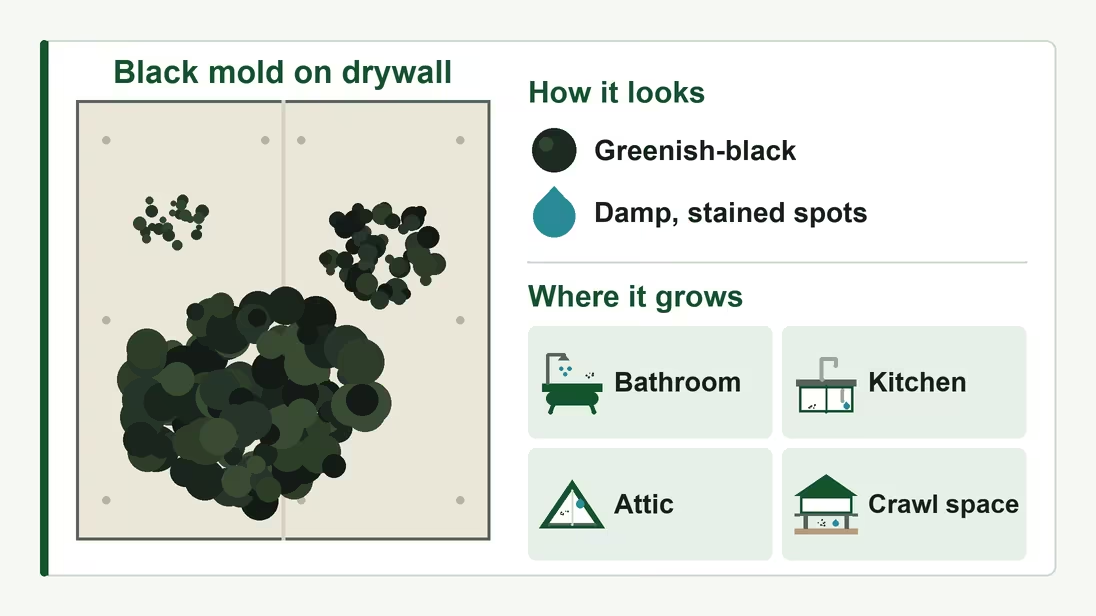
Black mold is the common name for Stachybotrys chartarum, which CDC describes as a greenish-black mold. Stachybotrys chartarum grows on material with high cellulose content, such as gypsum board, fiberboard and paper.
The growth of black mold depends on constant moisture, according to CDC. CDC states that it is not necessary to determine what type of mold is growing in a home. Stachybotrys chartarum is one of the common kinds of household mold, and the types page compares it with the others.
In short. Black mold is a colour name often used for Stachybotrys chartarum, not a diagnosis, a test result or a separate risk class. CDC treats all molds the same for health risks and removal, which answers whether black mold is more dangerous than other mold.
Is Black Mold More Dangerous Than Other Mold?
No, CDC recommends treating all molds the same with respect to potential health risks and removal. CDC reports that Stachybotrys chartarum and other molds may cause health symptoms that are nonspecific. According to CDC, no test exists that proves an association between Stachybotrys chartarum and particular health symptoms. CDC advises people with persistent symptoms to see their physician. Some people react to mold more strongly than others.
Source: CDC, Facts About Stachybotrys chartarum (link), checked 2026-10-15.
Who Is More Sensitive to Black Mold Exposure?
Mold sensitivity is a stronger reaction to mold than most people have. CDC names four groups as more sensitive to mold.
- People with asthma, who CDC says may have severe reactions to mold.
- People allergic to mold, who CDC says may have severe reactions.
- Immune-compromised people, who CDC says may get lung infections from mold.
- People with chronic lung disease, who CDC says may get lung infections from mold.
EPA notes that inhaling or touching mold or mold spores may cause allergic reactions in sensitive individuals. A person with symptoms asks a doctor, because this page gives general information, not a diagnosis.
What Does Black Mold Look Like?
Black mold looks like greenish-black growth on damp gypsum board, fiberboard or paper. CDC links its growth to materials with high cellulose content that stay wet. Four signs point to black mold growth in a home.
- A greenish-black colour, matching how CDC describes Stachybotrys chartarum.
- Growth on drywall, fiberboard, paper or other high-cellulose material, per CDC.
- A spot that stays wet from a leak, condensation or flooding, per CDC.
- Visible growth or a mold smell, since CDC says to remove mold that is seen or smelled.
These signs point to mold growth in a home, not to a particular species. The three names people use for this growth are compared in the table below.
| Term | What it names | Agency note |
|---|---|---|
| Black mold | A colour name in common use | CDC: the type need not be determined |
| Stachybotrys chartarum | The species CDC describes as greenish-black | CDC: grows on high-cellulose material with constant moisture |
| Mold of any colour | Any indoor mold growth | CDC: remove it, whatever the type |
The growth behind every name in the table depends on moisture, and black mold needs constant moisture.
Why Does Black Mold Grow in a House?
Black mold grows in a house where moisture stays on material rich in cellulose. CDC states that constant moisture is required for its growth. CDC names five moisture sources for black mold growth.
- Water damage, such as a past leak left wet.
- Water leaks, such as a supply line leaking inside a wall.
- Condensation, such as water forming on a cold surface.
- Water infiltration, such as rain entering through a roof or wall.
- Flooding, such as standing water inside the home.
EPA states that the key to mold control is moisture control. EPA advises drying water-damaged areas and items within 24-48 hours to prevent mold growth. Neither step depends on knowing the name of the mold growing in the home.
Source: EPA, A Brief Guide to Mold, Moisture and Your Home (link), checked 2026-10-15.
Do You Need to Test Black Mold to Know What It Is?
No, CDC does not recommend mold testing, and EPA says sampling is unnecessary in most cases when mold is visible. CDC states that the mold needs to be removed no matter what type is present. A provider sometimes samples during an assessment or a clearance check, as the provider's decision rather than a homeowner step. Orange Mold Remediation Help does not test or inspect. The testing page explains when mold testing is worth doing, and every case still ends in removal.
How Is Black Mold Remediation Done?
Black mold remediation is the work of fixing the moisture source and removing the growth while protecting the people in the home. The method is the same as for any mold, because CDC treats all molds the same for removal. Black mold remediation has five steps.
- Stop the moisture source. Fixing the leak or humidity first follows EPA guidance that moisture control is the key to mold control.
- Contain the work area. EPA sizes containment to the affected area, so a larger area gets more containment.
- Remove the growth. EPA favours physical removal over biocides, which it does not recommend as a routine practice.
- Dry the cleaned area. Drying completes the moisture fix that EPA includes in its definition of remediation.
- Check the result. The moisture problem is resolved and no growth is visible, per the EPA clearance criteria.
The provider decides the containment size and which materials are removed or cleaned. EPA advises not to run the HVAC system if the system itself is known or suspected to be contaminated with mold.
The process page details the steps of the mold remediation process, from the assessment to the rebuild. The homeowner's own part of the work depends on the size of the moldy area.
Can You Do Black Mold Remediation Yourself?
Yes, EPA says a homeowner can usually handle a moldy area smaller than about 10 square feet. Larger areas, growth inside walls and growth in the HVAC system are work for an independent local provider. EPA does not recommend chlorine bleach or other biocides as a routine practice during mold cleanup. The decision page weighs DIY or professional mold remediation by area, location and the people in the home.
Caution. EPA warns never to mix bleach with cleaners that contain ammonia.
How Much Does Black Mold Remediation Cost?
Black mold remediation follows the national range for any mold job, $1,200 to $3,750 per This Old House, updated 2026-03-11. The cost per square foot depends on the mold type, location and complexity of the job, according to This Old House. No black mold cost range for Orange, CA homes has a stated basis as of 2026-10-15. Six factors move the cost of black mold remediation.
- Affected area. More square feet of growth means more containment and labor, so the cost goes up. Basis: This Old House (square footage) and EPA, which scales containment at under 10, 10 to 100 and over 100 square feet.
- Location in the house. Growth inside walls, in an attic, a crawl space or HVAC ducts is harder to reach, so the cost goes up. Basis: This Old House (mold location).
- Extent of damage. Deeper damage to drywall and framing adds removal and rebuild work, so the cost goes up. Basis: This Old House (extent of damage).
- Materials. Removing porous material raises the cost more than cleaning a hard surface. Basis: EPA.
- Moisture source. The leak repair by another trade is a separate cost, and mold returns when the repair is skipped. Basis: EPA.
- Labor. Labor appears as its own line in the cost, so local labor rates shift the total. Basis: This Old House (labor).
Source: This Old House, Mold Remediation Cost (link), checked 2026-10-15.
The same six factors apply to black mold and to every other mold job in an Orange, CA home.
Mold type. This Old House notes that EPA cleanup advice does not distinguish between mold species.
The mold remediation cost overview for Orange, CA explains how mold remediation cost ranges are built and which factors move them.
Call to be connected with an independent local provider (000) 000-0000Free referral service; independent contractors. Read the full disclaimer.
Is Toxic Mold Remediation Different from Black Mold Remediation?
No. CDC treats all molds the same for removal, so a toxic label does not change the method.
What Is Non-Toxic Mold Remediation?
The phrase describes remediation that avoids harsh biocides. EPA does not recommend biocides as a routine practice during mold cleanup.
Is Crawl Space Black Mold Remediation Done Differently?
No, the steps stay the same. Access and containment in a crawl space change the work and its cost.
Call to be connected with an independent local provider (000) 000-0000Free referral service; independent contractors. Read the full disclaimer.